Market Insight • Ingredient Guide
Amla Powder: India's Best-Kept Export Secret is Going Global
Why nutraceutical brands, food manufacturers, and cosmetic companies across three continents are adding Indian gooseberry powder to their 2025–26 sourcing lists.
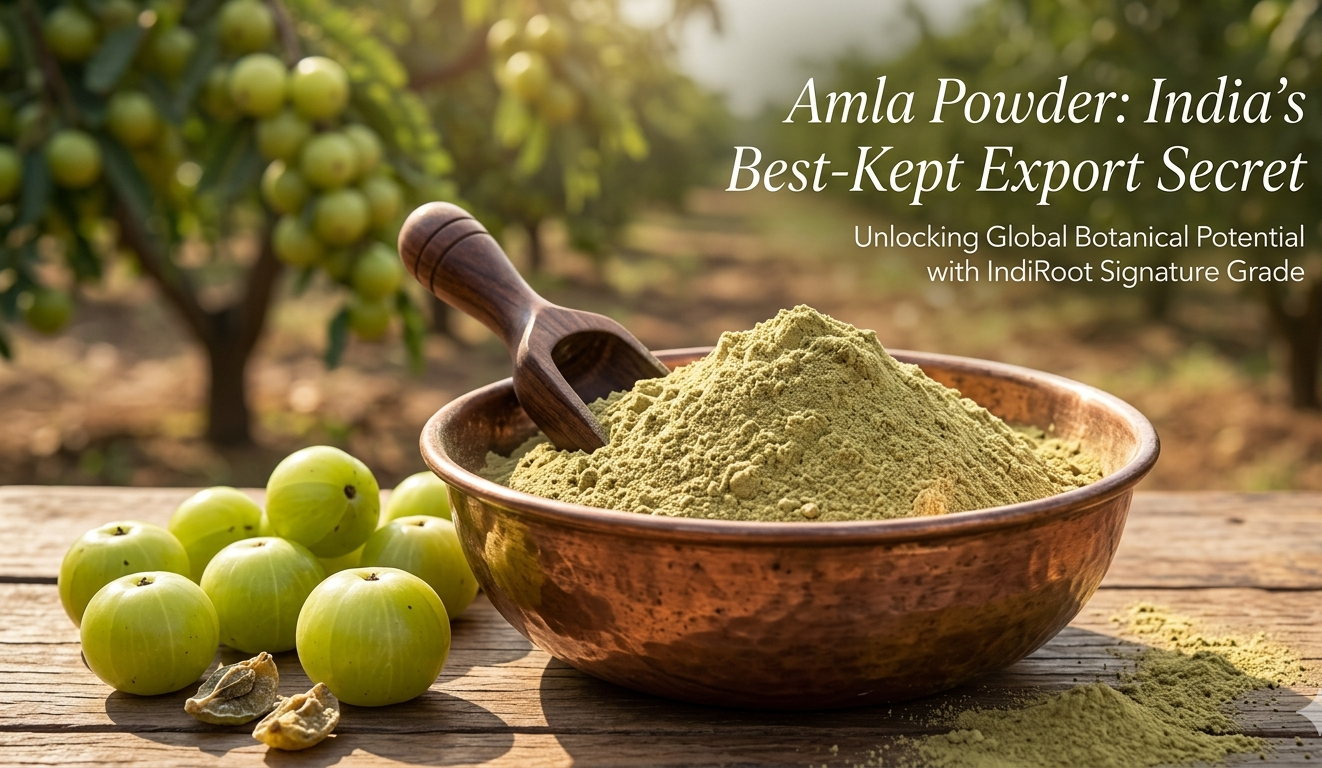
While moringa and turmeric have dominated wellness headlines for the past decade, a quieter revolution has been building. Amla — the Indian gooseberry used in Ayurveda for over 3,000 years — is now one of the fastest-growing botanical ingredients in global B2B sourcing. And India, its original home, remains the world's single largest producer.
If you are a procurement manager, product developer, or brand owner in the nutraceutical, functional food, or personal care space, this is not a trend to ignore. The data is unambiguous, the applications are expanding, and the sourcing window for competitive pricing from India is right now.
The Numbers Don't Lie: A Market in Full Acceleration
The global amla extract and powder market is experiencing sustained, broad-based growth that cuts across multiple end-use industries. Here is what the current market data shows:
What makes this growth particularly meaningful for B2B buyers is where it is happening. North America accounts for nearly 25% of global demand, driven by rising consumer interest in Ayurvedic and herbal supplements. Europe is following closely, with Germany and France both registering strong CAGR in botanical powder imports. And Southeast Asia — particularly Japan and Malaysia — is seeing accelerated uptake in both food formulation and premium cosmetics.
Key Market Signal
In March 2025, Amazon, Walmart, and Costco all reported a notable surge in sales of Ayurvedic and herbal supplements including amla capsules and amla powder — reflecting a measurable shift in mainstream Western consumer behaviour toward botanical wellness ingredients.
For importers, this is the signal that demand is not niche anymore. It is moving from the health food store shelf to the mass market — and supply chains need to be built now.
What Is Amla Powder, and Why Does It Matter to Formulators?
Amla powder is derived from the Indian gooseberry (Emblica officinalis), a small green fruit native to the Indian subcontinent. It is one of the richest natural sources of Vitamin C on the planet — and unlike synthetic ascorbic acid, the Vitamin C in amla is bound with tannins, flavonoids, and polyphenols that dramatically improve its bioavailability and stability.
For product developers, this distinction matters enormously. When a consumer takes a Vitamin C supplement from a bottle, they typically receive isolated ascorbic acid. When they take an amla-based product, they receive a full-spectrum botanical complex — a formulation advantage that resonates powerfully in today's clean-label market.
Key bioactive compounds in amla powder include:
- ✓ Emblicanin A and B — powerful antioxidants unique to amla, with superior free radical scavenging activity.
- ✓ Punigluconin and Pedunculagin — polyphenols linked to anti-inflammatory and cardioprotective properties.
- ✓ Gallic acid and Ellagic acid — phenolics with documented antioxidant, anti-aging, and antimicrobial activity.
- ✓ Natural Vitamin C complex — up to 20x higher concentration than oranges, with enhanced stability due to tannin binding.
- ✓ Quercetin and Kaempferol — flavonoids that support immune function and metabolic health.
Three Industries, One Ingredient: The Multi-Sector Opportunity
What makes amla powder genuinely unique as an export commodity is its ability to serve three entirely distinct global industries. This cross-sector versatility is rare and creates a supply diversification advantage for importers who establish a reliable sourcing relationship early.
Nutraceuticals & Supplements
The largest category (40% demand). Used in immunity blends, antioxidant capsules, and Ayurvedic lines. In the US, 30% of new 2024 botanical launches included amla.
Functional Food & Beverage
Holds 34% market share. Amla integrates into immunity shots, teas, protein blends, and health bars without dominating flavor profiles.
Cosmetics & Personal Care
High Vitamin C and gallic acid make it a premium ingredient for anti-aging serums, hair care products, and luxury spa treatments.
Pharmaceutical Applications
Gaining traction in phytopharmaceuticals targeting blood glucose regulation, cholesterol management, and liver health research.
Understanding the Grades: What to Specify When You Source
The drying method and raw material quality have a significant impact on color, potency, and shelf life. Here is our practical guide for importers:
| Grade / Type | Process | Best For | Key Advantage |
|---|---|---|---|
| Shade-Dried | Slow-dried at ambient temperature | Ayurvedic & premium supplements | Maximum nutrient and Vitamin C preservation. |
| Hot Air-Oven Dried | Controlled-temperature oven | Food & functional foods | Consistent moisture; cost-effective for large volumes. |
| Spray-Dried | Extract to powder conversion | Drink mixes & effervescents | Superior water solubility; beverage line compatible. |
| Organic Certified | Certified raw material | EU, USA, UK retail brands | Meets strict pesticide MRL standards. |
Why Source from India? The Origin Advantage
India is not just a supplier — it is the origin. This matters for several reasons:
Agro-climatic excellence: The semi-arid conditions of Uttar Pradesh, Madhya Pradesh, and Gujarat produce fruit with naturally higher bioactive concentrations than elsewhere.
Scale & Infrastructure: India's established industry means consistent quality parameters, lab testing, and internationally compliant documentation.
"India's organic product exports including amla grew 34.6% year-on-year in FY 2024–25 — the supply chain is scaling precisely when global demand is accelerating."
Regulatory alignment: We supply full documentation: Lot-specific COA, Phytosanitary Certificates, and residue reports aligned with EU MRL and US FDA standards.
What Smart Importers Ask Before Ordering
- Is the Certificate of Analysis lot-specific, or generic?
- What drying temperature is used to preserve Vitamin C activity?
- Are residue reports from an independent, accredited lab?
- Does the supplier distinguish between "naturally grown" and formally certified organic?
- What is the confirmed lead time to FOB shipment?
- Is private-label packaging available for your fill weight and material?
- Can the supplier provide reference samples before a full commercial order?
The Competitive Window Is Now
The brands that will dominate their categories with amla-based products in 2027 are placing their sourcing partnerships in 2025 and 2026. This is the pattern seen with moringa and turmeric. Early-mover brands secure preferential pricing and supply exclusivity before demand peaks. Amla is in that window right now.
Source Amla Powder from IndiRoot Exims
Based in Gujarat, India — we supply shade-dried and spray-dried amla powder to food, nutraceutical, and cosmetic brands globally. Request a technical spec sheet and sample with no commitment required.
📩 Request Samples & Specs