Market Insights • Ingredient Sourcing • 2026 Trends
Banana Powder in 2026: The Multi-Industry Ingredient Global Brands Can't Ignore
Five global industries are converging on the same plant-based ingredient this year. Here's the full breakdown — market data, grade guide, and sourcing checklist.
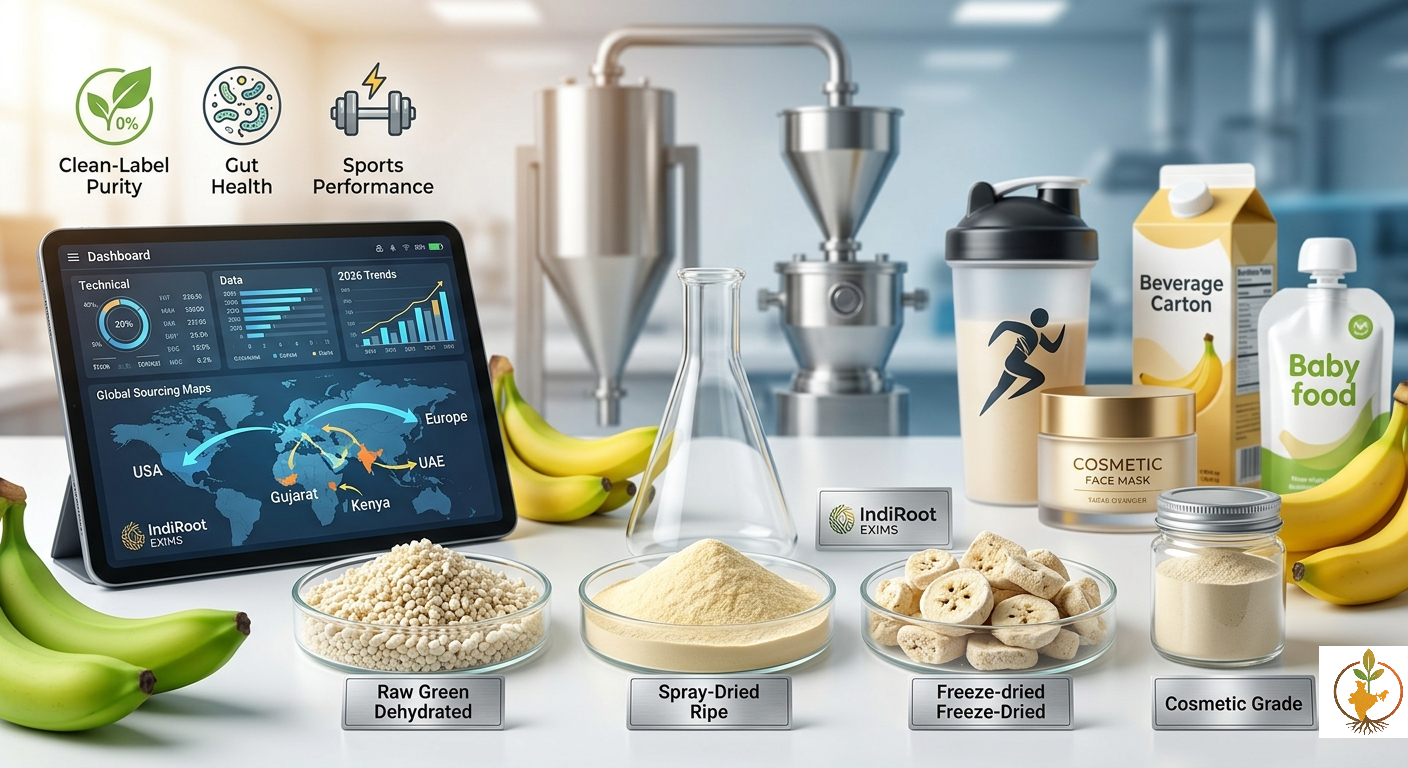
India is the world's largest banana producer by volume. But the real commercial story in 2026 isn't fresh fruit — it's what happens after the harvest. Banana powder, once a niche ingredient in infant cereals and regional bakeries, has become one of the most strategically valuable plant-based inputs across five global industries — simultaneously.
The numbers confirm it: the global banana powder market is currently valued at $2.1 billion and is growing at a 7.4% CAGR through 2030. More importantly, the application landscape has diversified dramatically — nutraceuticals, functional beverages, sports nutrition, infant food, and clean-label cosmetics are all competing for the same ingredient from the same origin.
For procurement heads, brand formulators, and ingredient buyers, understanding this shift — and acting on it — is a competitive advantage that compounds over time.
1. Why 2026 is the Inflection Point
Three powerful macro trends have converged to push banana powder into mainstream procurement decisions globally:
Clean-label pressure: Consumers in North America, Western Europe, and the GCC are demanding transparent ingredient lists. Banana powder — a single-origin, minimally processed, instantly recognisable ingredient — passes the clean-label test that synthetic additives increasingly fail. Brands reformulating away from maltodextrin, artificial flavours, or synthetic sweeteners are finding banana powder a credible, marketable alternative.
Gut health is the decade's defining wellness trend: The global prebiotic supplement market is expanding at over 8% annually. Green banana powder, with its high Resistant Starch (RS2) content, is one of the most potent natural prebiotic ingredients available at commercial scale — at a price point that makes it viable for mass-market formulations, not just premium niche products.
Sports nutrition premiumisation: Elite and lifestyle athletes are shifting from synthetic to plant-based recovery inputs. Banana powder's natural potassium, magnesium, and carbohydrate profile makes it a credible, marketable alternative to synthetic electrolyte blends — with the added commercial advantage that consumers actually recognise the ingredient on the label.
2. Five Industries, One Ingredient
What makes banana powder exceptional in 2026 is not any single application — it's the breadth of industries actively sourcing it at commercial scale:
💊 Nutraceuticals & Gut Health Supplements
Green banana powder contains one of the highest natural concentrations of RS2 Resistant Starch available at commercial scale. RS2 acts as a prebiotic — feeding beneficial gut bacteria, improving digestion, and supporting the microbiome. With the prebiotic market growing at 8%+ annually, this is the fastest-growing end-use category for banana powder globally. The clinical credibility is there; the ingredient now needs the right sourcing story to match.
Grade required: Raw Green Dehydrated
🥤 Beverages & Functional Drinks
Spray-dried ripe banana powder dissolves cleanly and instantly — no clumping, no separation. It adds natural sweetness and authentic banana flavour to RTD shakes, protein powders, smoothie blends, and meal replacement formats without refined sugar or artificial flavouring. For beverage brands operating in the clean-label space, this grade is now a core formulation input.
Grade required: Spray-Dried Ripe
🏋️ Sports Nutrition
The fastest-growing new application category in 2026. Brands and athletes are replacing synthetic electrolyte compounds with banana powder's natural potassium and magnesium profile. Beyond the functional benefits, the commercial driver is just as powerful: consumers recognise "banana powder" on an ingredient list in a way they simply don't recognise "dipotassium phosphate." Clean label plus functional performance is a powerful product story.
Grade required: Freeze-Dried or Spray-Dried
👶 Infant & Clinical Nutrition
One of the oldest and most established applications — but evolving rapidly. Banana powder's natural sweetness, high digestibility, and allergen-free profile have made it a cornerstone of infant cereals and weaning food formulations for decades. The 2026 shift is towards organic-certified grades as regulatory scrutiny on pesticide residues in infant food tightens in the EU and North America.
Grade required: Organic Spray-Dried
✨ Cosmetics & Personal Care (The Surprise Entrant)
This is the application most procurement teams don't see coming. Natural potassium, vitamin B6, and the soft, absorbent texture of fine-milled banana powder are being incorporated into face masks, hair treatments, body scrubs, and natural deodorant formulations — particularly in K-Beauty and clean-beauty brands in South Korea, the UAE, and Western Europe. As the cosmetic industry's "food-grade ingredient" trend accelerates, banana powder is emerging as a credible hero ingredient with a recognisable consumer story.
Grade required: Fine-Milled Cosmetic Grade
3. The Grade Decision Matrix
Not all banana powder is the same — and the global market is rife with mislabelled or misapplied grades. Matching grade to application is the first and most critical sourcing decision. Here is the comparison every formulation team needs:
| Grade | Resistant Starch | Sugar Content | Solubility | Primary Applications |
|---|---|---|---|---|
| Raw Green Dehydrated | High (RS2) | Very Low | Partial | Prebiotic supplements, gut health, gluten-free baking |
| Spray-Dried Ripe | Low | Naturally High | Fully Soluble | Beverages, RTD shakes, infant nutrition, meal replacements |
| Freeze-Dried | Medium | Medium | High | Sports nutrition, premium nutraceuticals, flavour-sensitive formats |
| Organic Certified | Varies by type | Varies by type | Varies by type | EU/US retail-facing brands, clean-label certification, infant food |
Raw green dehydrated and ripe spray-dried are not interchangeable. One is high in resistant starch and low in sugar — engineered for gut health formulations. The other is high in natural sugars and fully water-soluble — designed for beverages and ready-to-drink applications. Sourcing the wrong grade for your application is a formulation risk, not just a quality issue.
4. What Every Procurement Team Must Verify Before Buying
The banana powder market has a quality problem. Rapid demand growth has attracted suppliers who cut corners on testing, labelling, and documentation — creating supply chain risks for brands operating in regulated markets. Here is what rigorous procurement looks like:
- Lot-specific COA, not generic: Every shipment must carry its own Certificate of Analysis tied to the specific production lot. A blanket document valid for months is not acceptable for regulated market entry.
- Pesticide residue testing to international MRL standards: Especially critical for organic-certified grades and brands selling into the EU or US retail channel. Testing should cover 200+ multi-residue pesticides.
- Heavy metal panel included: Lead, cadmium, arsenic, and mercury must be tested and reported per lot. This is non-negotiable for nutraceutical and infant nutrition applications.
- Drying method and temperature disclosed: Excessive heat during processing degrades resistant starch content and bioactive compounds. The drying method is a direct quality indicator — always request it.
- Moisture content confirmed: High moisture in powder is a shelf-life and microbial risk. Request moisture content data as part of the COA, not as an afterthought.
- Private-label and export packaging capability: If you are a brand — not just a distributor — your supplier must have the capability to pack under your label without routing through a third-party co-packer.
If your current supplier cannot provide all six without delay, that is a supply chain risk you are carrying into every product launch.
5. Why Serious Buyers Source from India — and Why Now
India is not just the world's largest banana producer by volume — it is home to a dedicated processing ecosystem that no other origin can currently match for quality, documentation, and price-to-performance ratio.
Processing hubs in Tamil Nadu, Gujarat, and Maharashtra now operate with export-standard GMP infrastructure, multi-grade production capability, and routine compliance with US FDA, EU, and UAE food safety frameworks. This is why the region consistently wins repeat business from multinational buyers across North America, the Middle East, and East Africa.
The strategic sourcing window that exists right now — before global demand fully catches up with premium Indian supply — is a genuine competitive advantage. The brands locking in supply partnerships in 2026 will have pricing and continuity advantages that late movers will pay a significant premium to replicate.
Export Specifications — IndiRoot Exims Banana Powder
| Grades Available: | Raw Green Dehydrated, Spray-Dried Ripe, Freeze-Dried, Organic Certified |
| MOQ: | 500 kg (FOB) |
| Packaging: | 20–25 kg food-grade multi-layer moisture-barrier bags; private label available |
| Pricing Terms: | FOB & CIF available |
| Documentation: | Lot-specific COA, SDS, Pesticide & Heavy Metal Reports provided per shipment |
| Markets Served: | USA · UAE · Europe · Kenya · Southeast Asia |
| Certifications: | GMP, NPOP Organic (on request), FSSAI — documentation available per order |
Ready to source the right grade of banana powder for your formulation? IndiRoot Exims provides full technical documentation, competitive FOB & CIF pricing, and private-label packaging for global buyers.
📩 Request Technical Specifications & Quote