Market Insight • Ingredient Sourcing • 2026 Guide
Tomato Powder from India: The One Ingredient Every Sauce, Snack and Ready-Meal Brand Is Quietly Re-Sourcing in 2026
Spray-dried vs drum-dried, the specs that actually matter, and a sourcing checklist for 2026.
Published: 02 September 2026
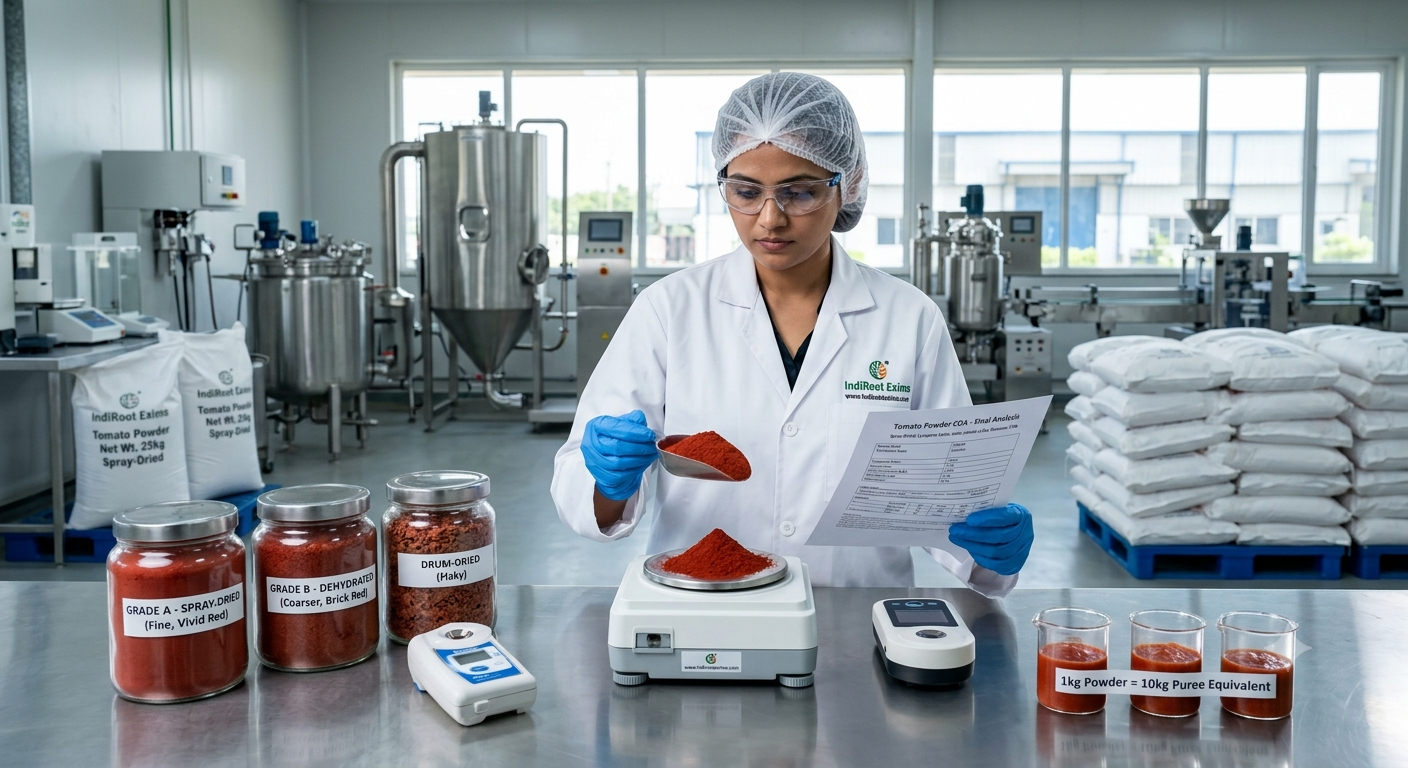
Most procurement teams still treat tomato powder like a commodity — buy on price, done. That thinking is starting to cost them. Tomato paste and canned tomato prices have been volatile for two years running, and buyers are discovering that a well-specified powder isn't just a cheaper substitute — it's a more stable one. One kilogram of good spray-dried tomato powder rehydrates into roughly 10–15 kg of fresh tomato puree equivalent, which changes the freight and storage math for any manufacturer shipping internationally.
India has quietly become one of the countries best positioned to supply this shift. It's the world's second-largest tomato producer, with processing clusters in Andhra Pradesh, Madhya Pradesh and Karnataka giving exporters scale that keeps pricing competitive even as demand rises.
This is your 2026 sourcing guide: what actually separates a good tomato powder from a mediocre one, what it costs, and how to vet a supplier before you commit to a container.
Why Tomato Powder Is Having a Moment
Five buyer categories are driving the current demand curve:
- Seasoning and spice blenders — tomato powder is a base note in nearly every commercial masala, taco seasoning, and savory spice mix
- Snack manufacturers — dusted onto chips, crackers and extruded snacks for tomato/pizza flavor lines
- Soup, sauce and ready-meal producers — used to standardize color and acidity batch to batch, something fresh tomatoes can't guarantee
- Instant noodle and dry-mix brands — a shelf-stable way to deliver tomato flavor without moisture that would compromise shelf life
- Nutraceutical formulators — increasingly interested in the lycopene content for antioxidant-positioned supplements
What connects all five is the same pain point: fresh tomato and tomato paste pricing swings hard with weather and season. Powder, properly sourced, doesn't.
Spray-Dried vs Drum-Dried: The Grade Decision That Actually Matters
Most quality disputes with tomato powder trace back to buyers not specifying the drying method upfront.
Spray-dried tomato powder
- Finer, more uniform particle size (typically 100–300 microns)
- Fully water-soluble — dissolves cleanly in hot or cold liquid without grit
- Preferred for beverages, dressings, cold-mix applications, and premium snack seasoning
- Commands the higher end of the price range
Drum-dried / dehydrated tomato powder
- Coarser texture, slightly less soluble
- More cost-effective for applications where the powder is cooked into a matrix anyway (soup bases, bouillon, extruded snacks)
- Often the better value pick when solubility isn't the deciding factor
Neither is "better" in the abstract — it depends on your application. The mistake is not specifying it at all and letting the exporter choose.
The Specs That Determine Performance
Before you accept a sample, ask for lab data on these four:
| Parameter | What to look for | Why it matters |
|---|---|---|
| Moisture content | Below 8% | Higher moisture causes caking and clumping in transit and storage |
| Lycopene content | Supplier-declared, batch-tested | Drives both color intensity and the nutraceutical value proposition |
| Color value (ASTA / Lycopene index) | Consistent across lots | Determines whether your finished product looks the same batch to batch |
| Mesh size / particle size | Matched to your process | Wrong mesh size means re-processing on your end, which erodes your margin |
A supplier who can't produce this data on request — not "we can arrange it eventually," but a COA per lot — isn't ready for a long-term contract.
What It Costs (2026)
Export FOB pricing for Indian tomato powder currently runs in a wide band — roughly US$3–8 per kg, with the spread driven by drying method, lycopene/color value, and moisture spec rather than by origin state or exporter size. Buyers who negotiate on price alone tend to get pushed toward the bottom of that range on quality too. Experienced buyers negotiate on consistency and supply assurance first, price second — because a cheaper lot that cakes in transit or varies in color from shipment to shipment costs more in rework than it saved at the port.
Seasonal tomato supply also affects processor capacity, so if your volumes allow it, planning purchases around India's peak processing windows can improve both price and lead time.
Trade Classification
Indian tomato powder is exported under HS Code 0712.90 (dried vegetables, powder form, not further prepared) — the same broad heading used for onion and garlic powder. If your customs broker is quoting a different code, it's worth double-checking the paperwork before the shipment leaves port.
A Quick Sourcing Checklist
Before you commit to a full container:
- Specify drying method (spray-dried or drum-dried) in writing — don't leave it to the exporter's default
- Request a COA per lot, not a one-time sample certificate
- Confirm moisture spec (<8%) and ask how it's tested
- Ask for phytosanitary certificate and FSSAI/export documentation as standard, not an add-on
- Start with a paid sample and small trial order before scaling to full MOQ
- Clarify packaging — food-grade, moisture-barrier bags (typically 20–25 kg) are non-negotiable for a product this sensitive to humidity
Looking for a Reliable Tomato Powder Supplier? IndiRoot Exims processes and exports dehydrated tomato powder from Indian growing regions, with full COA, SDS, pesticide and heavy-metal reports on every lot. Standard MOQ is 500 kg (FOB), with private-label and bulk options available.
📩 Get a Wholesale Quote