Market Insight • Ingredient Sourcing • 2026 Trends
Turmeric & Curcumin Powder: India's Golden Export is Going Global
Why nutraceutical brands, food manufacturers, pharmaceutical companies, and cosmetic houses across four continents are making Indian turmeric their 2026 sourcing priority.
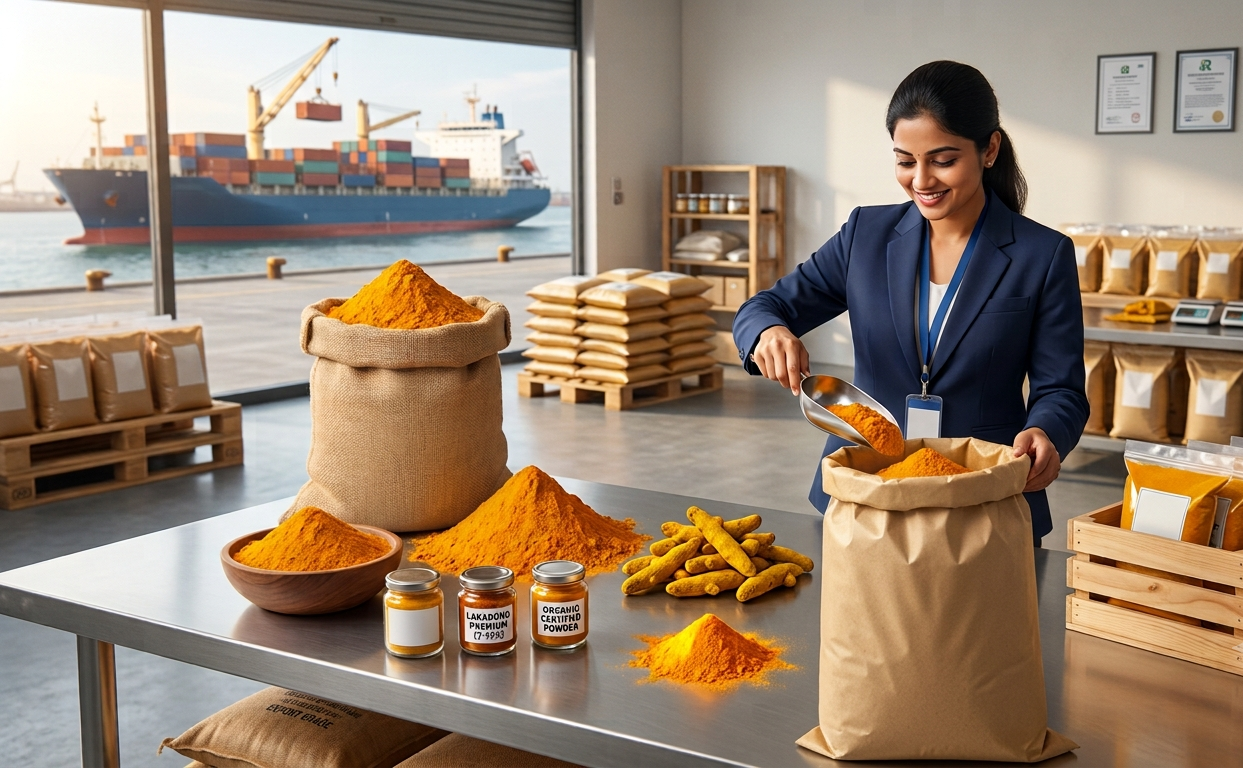
Moringa captured the wellness headlines. Amla built its case in Ayurvedic supplement aisles. But the ingredient that has defined Indian botanicals in the global imagination for centuries — and is now delivering its strongest B2B commercial performance in history — is turmeric.
In 2026, the story is no longer just about the spice rack. Standardised curcumin powder, high-potency turmeric extracts, and export-grade turmeric powder are now active procurement priorities for pharmaceutical R&D teams, nutraceutical formulators, functional food brands, and premium cosmetic houses simultaneously. And India — which produces over 75% of the world's turmeric — sits at the centre of that supply chain.
If you are a procurement manager, product developer, or ingredient buyer, this is the market intelligence and sourcing guide you need before placing your next order.
1. The Numbers Don't Lie: A Market in Full Acceleration
The global turmeric market is not a niche wellness story — it is a large-scale, multi-sector commodity trade in rapid expansion. The broader turmeric market, encompassing powder, fingers, oleoresins, and extracts, was valued at $6.24 billion in 2025 and is projected to reach $10.32 billion by 2033 at a CAGR of 6.5%. Within that, the higher-value curcumin extract and standardised powder segment tells an even more compelling story: growing from roughly $222 million in 2025 to a projected $427 million by 2032, at a CAGR approaching 11%.
Powder formulations dominate, commanding approximately 68–73% of total curcumin market share — reflecting the versatility powder offers across capsule manufacturing, food processing, and cosmetic formulation. The fastest-growing application category is cosmetics and personal care, projected to grow at over 12% annually through 2031 — a signal that turmeric's commercial story is expanding well beyond its traditional health supplement base.
🔑 Key Market Signal
India's National Turmeric Board, established in January 2025 and headquartered in Nizamabad, Telangana, has set a target of $1 billion in annual turmeric exports by 2030 — up from approximately $212 million in FY 2023–24. With a 20% increase in India's 2025 harvest and expanded processing infrastructure, the supply chain is scaling precisely when global demand is accelerating.
2. What Is Turmeric Powder — and Why Does It Matter to Formulators?
Turmeric powder is derived from the dried and ground rhizomes of Curcuma longa, native to the Indian subcontinent. Its active bioactive compound — curcumin — is a polyphenol responsible for turmeric's deep yellow-orange colour, anti-inflammatory activity, and broad-spectrum therapeutic properties.
For product developers, the critical distinction is between standard turmeric powder (whole-ground, typically 2–5% curcumin) and standardised curcumin extract (concentrated, typically 95% curcumin by HPLC). Food and beverage applications generally specify culinary-grade powder for flavour and natural colouring. Nutraceutical and pharmaceutical applications demand standardised extracts with verified curcumin concentration and bioavailability documentation.
Key bioactive compounds in turmeric powder relevant to your formulation team:
- Curcumin — primary polyphenol; anti-inflammatory, antioxidant, FDA GRAS status confirmed
- Demethoxycurcumin & Bisdemethoxycurcumin — complementary curcuminoids in the natural complex
- Turmerones (ar-, α-, β-) — sesquiterpenes shown to enhance curcumin bioavailability
- Zingiberene — shared with ginger; digestive support and anti-nausea properties
- Polysaccharides (ukonan A–D) — immunomodulatory activity under active research interest
The critical bioavailability challenge — curcumin's hydrophobic nature limits intestinal absorption — has driven significant R&D into piperine co-administration, nanoencapsulation, liposomal delivery, and phospholipid complexes. Specifying the intended delivery format upfront determines which grade and processing specification to source.
3. Four Industries, One Ingredient: The Multi-Sector Opportunity
What gives turmeric powder its exceptional B2B value proposition in 2026 is the breadth of industries actively sourcing it at commercial scale — each with distinct grade requirements, regulatory frameworks, and application drivers.
Nutraceuticals & Supplements
Pharmaceutical-grade curcumin (95% standardised) dominates — anti-inflammatory capsules, joint health formulas, immunity blends, and Ayurvedic lines. North America holds 50%+ of global demand in this segment. Bioavailability-enhanced formats (piperine, liposomal) command significant pricing premiums.
95% Standardised CurcuminFunctional Food & Beverage
Food-grade turmeric powder with GRAS status integrates into golden milk blends, immunity shots, functional teas, protein powders, and health bars. Clean-label demand is the primary driver — turmeric replaces synthetic yellow dyes now under regulatory pressure across EU product lines.
Food-Grade Turmeric PowderCosmetics & Personal Care
The fastest-growing application segment (12%+ CAGR). Anti-inflammatory and antioxidant properties drive uptake in face serums, brightening masks, hair care, and body treatments. Europe leads the cosmetic market; K-Beauty brands in South Korea and GCC luxury cosmetics are rapidly accelerating adoption.
Cosmetic-Grade ExtractPharmaceutical & Clinical
The largest revenue segment (52%+ market share) for curcumin specifically. Applications span gastrointestinal health, oncology research, dermatology, and metabolic syndrome management. Buyers require HPLC-verified curcumin %, independent COA, and GMP-certified manufacturing documentation.
Pharmaceutical-Grade Extract4. Understanding the Grades: What to Specify When You Source
India's turmeric processing ecosystem produces multiple grades suited to different end applications. Specifying the wrong grade is a formulation and compliance risk — not merely a quality inconvenience.
| Grade / Type | Curcumin % | Best For | Key Advantage |
|---|---|---|---|
| Culinary / Food-Grade Powder | 2–4% (HPLC) | Food & beverage, golden milk, natural colouring, spice blends | GRAS status; wide regulatory acceptance; clean label positioning |
| High-Curcumin Powder (Alleppey / Erode) | 4–7% (HPLC) | Enriched supplements, premium functional food & beverage | Higher bioactive density without requiring an extraction step |
| Standardised Curcumin Extract | 95% (HPLC) | Pharmaceutical, clinical supplements, cosmetics | Maximum potency; precise dosing; pharma-grade documentation |
| Organic Certified Powder | 2–5% (HPLC) | EU & USA retail brands, clean-label, infant nutrition | Meets strict pesticide MRL standards; supports retail brand positioning |
| Lakadong Premium Grade | 7–12% (HPLC) | Ultra-premium supplements, specialty cosmetics, high-value F&B | World's highest natural curcumin content; commands significant price premium |
⚠️ Critical Sourcing Note
Always specify HPLC testing for curcumin content — the only internationally accepted method for accurate quantification. UV spectrophotometry (a common supplier shortcut) overestimates curcumin readings by 20–40% versus HPLC. A supplier unable to provide an HPLC-verified COA is a compliance risk for any regulated market entry.
5. Why Source from India? The Origin Advantage
India is not merely a supplier — it is the origin. This distinction carries commercial, regulatory, and quality implications that no other producing country can currently replicate at scale.
Agro-Climatic Superiority. India's turmeric belts span diverse growing conditions — Telangana and Andhra Pradesh for high-volume finger grades, Tamil Nadu's GI-tagged Erode and Salem varieties for vibrant colour, Maharashtra's Sangli for premium powder processing, and Meghalaya's Lakadong village for record-high curcumin content of 7–12%. No single competing origin offers this variety-specific range.
Scale, Infrastructure & Government Support. India produces over 75% of global turmeric supply and approximately 60% of global exports by volume. The 2025 harvest was estimated at 450,000 metric tons — a 20% increase over the prior year — supported by expanded cultivation and the National Turmeric Board, which focuses on improving export quality standards, R&D, and international market promotion.
Regulatory Alignment. Indian exporters operating with GMP, FSSAI, ISO 22000, HACCP, and APEDA certifications can supply full documentation packages aligned with US FDA requirements, EU food safety MRLs, Japan's Ministry of Health standards, and UAE ESMA compliance. Curcumin holds FDA GRAS Notice 822 status — enabling confident expansion into US food and beverage applications without additional regulatory burden.
6. What Smart Importers Ask Before Ordering
- Is the Certificate of Analysis lot-specific and verified by an independent, NABL-accredited laboratory — not a generic blanket document?
- Is curcumin content confirmed by HPLC method, not UV spectrophotometry?
- What is the ASTA colour value per ASTA Method 20.1 — critical for food and cosmetic natural colouring applications?
- Are pesticide residue reports covering 200+ multi-residues included per batch, aligned with EU MRL and US FDA standards?
- Is a heavy metal panel (lead, cadmium, arsenic, mercury) tested and reported per shipment?
- Does the supplier distinguish between "naturally grown" and formally certified organic — with full certification documentation?
- What is the processing and drying method? Excessive heat degrades curcumin content and volatile oils — a quality indicator no serious supplier should refuse to disclose.
- Is private-label and export packaging (25–50 kg food-grade, UV-protective bags) available directly from the supplier?
7. The Competitive Sourcing Window Is Now
The brands that will command their categories with turmeric and curcumin-based products through 2028 are establishing their supply partnerships in 2026. This is the pattern seen repeatedly with moringa, amla, and ashwagandha — early-mover brands lock in preferential pricing, supply continuity, and product launch exclusivity before demand peaks.
Turmeric is not early-stage. But the shift toward standardised, documented, high-purity curcumin sourcing from verified Indian suppliers — as opposed to commodity-grade, undifferentiated product — is still actively underway. The brands positioning their supply chains for this quality shift now will be rewarded when regulatory scrutiny in the EU, UK, and USA tightens further on botanical ingredient documentation requirements. The sourcing window for competitive pricing on premium, lab-verified Indian turmeric powder and curcumin extract is open. It will not remain so indefinitely.
Export Specifications — IndiRoot Exims Turmeric & Curcumin Powder
| Grades Available: | Food-Grade Turmeric Powder · High-Curcumin Powder (4–7%) · Standardised Curcumin Extract (95%) · Lakadong Premium (7–12%) |
| Curcumin Content: | 2–4% (culinary) · 4–7% (high-curcumin) · 95% (standardised extract) · 7–12% (Lakadong) — all verified by HPLC |
| MOQ: | 500 kg (FOB) |
| Packaging: | 20–25 kg food-grade multi-layer moisture-barrier bags; UV-protective outer; private label available |
| Shelf Life: | 18–24 Months (stored in cool, dry conditions) |
| Pricing Terms: | FOB & CIF available |
| Documentation: | Lot-specific COA (HPLC) · Pesticide Multi-Residue Report · Heavy Metal Panel · Phytosanitary Certificate · Certificate of Origin |
| Markets Served: | USA · UAE · Europe (EU & UK) · Japan · Malaysia · Kenya · Southeast Asia |
| Certifications: | GMP · FSSAI · APEDA · NPOP Organic (on request) · ISO 22000 / HACCP — documentation available per order |
Source HPLC-verified turmeric powder and standardised curcumin extract from IndiRoot Exims. Request a technical spec sheet and sample with no commitment required.
📩 Request Samples & Specifications